

Another World is Possible
Your Attention is Requested in a Better Reality – Speculative Design & Design Fictions


Harnessing Imagination:
Measuring Reality by Ideals
In her 2014 acceptance speech of the National Book Foundation Medal for Distinguished Contribution to American Letters, Ursula K. Le Guin, acknowledged hard times ahead. She noted, as one of the United State’s most distinguished authors, specifically of Sci-Fi and Fantasy, that the world needed “writers who can see alternatives to how we live now, can see through our fear-stricken society and its obsessive technologies to other ways of being, and even imagine real grounds for hope. We’ll need writers who can remember freedom — poets, visionaries — realists of a larger reality.”
Our current reality, if we can find a single reality to agree on, often feels destabilizing, oppressive and all encompassing. In the realm of imagination, apocalypse feels more accessible than freedom. Climate change, corruption, unregulated AI, wealth inequality and war are filtered through endless scrolls and fractured algorithms designed to monopolize attention. The present is defined by disillusionment. But colliding realities and collapsing frameworks are opportunities for dreamers. It is time to look clearly at the world, as it actually is, and imagine more.
“Ideals are not measured by whether they conform to reality; reality is judged by whether it lives up to ideals. Reason’s task is to deny that the claims of experience are final—and to push us to widen the horizon of our experience by providing ideas that experience ought to obey.”
Susan Neiman, Moral Philosopher
Navigating uncertainty requires a conviction that acknowledges fear and continues on. Designers and artists working at the intersection of function, form, and human experience, are well-positioned for this moment. Design, by its nature, assumes that alternatives are possible. At a time when empathy and artistry are under threat, imagination can become a quiet hope – listening closely, asking good questions and provoking new possibilities. To build another world, a better world, it must be dreamed of first.
Orchestrating Attention:
The Role of Artists & Designers
“For me, design is so often an argument about how to see the world, about what to pay attention to and in what order. It is a practice of perspective and scope, and therefore it requires the ability to step outside of every habitual way of seeing…the role of the artist and designer that’s most important to me right now is indeed one as an orchestrator of attention, someone who can create the lenses with which we can see a completely different reality–not one that is imaginary or fabricated, but that has in fact been there all along.”
Jenny Odell, author of How to Do Nothing
If, like Jenny Odell, we think of the role of the artist and designer as a sense-maker, as one who orchestrates attention and reveals new paradigms, the standards for which to describe and measure a creative practice must be reconsidered. In Speculative Everything: Design, Fiction, and Social Dreaming, Anthony Duane & Fiona Raby summarize their A/B manifesto that compares design both as it is typically understood (A) with their approach rooted in Speculative Design & Design Fiction (B).
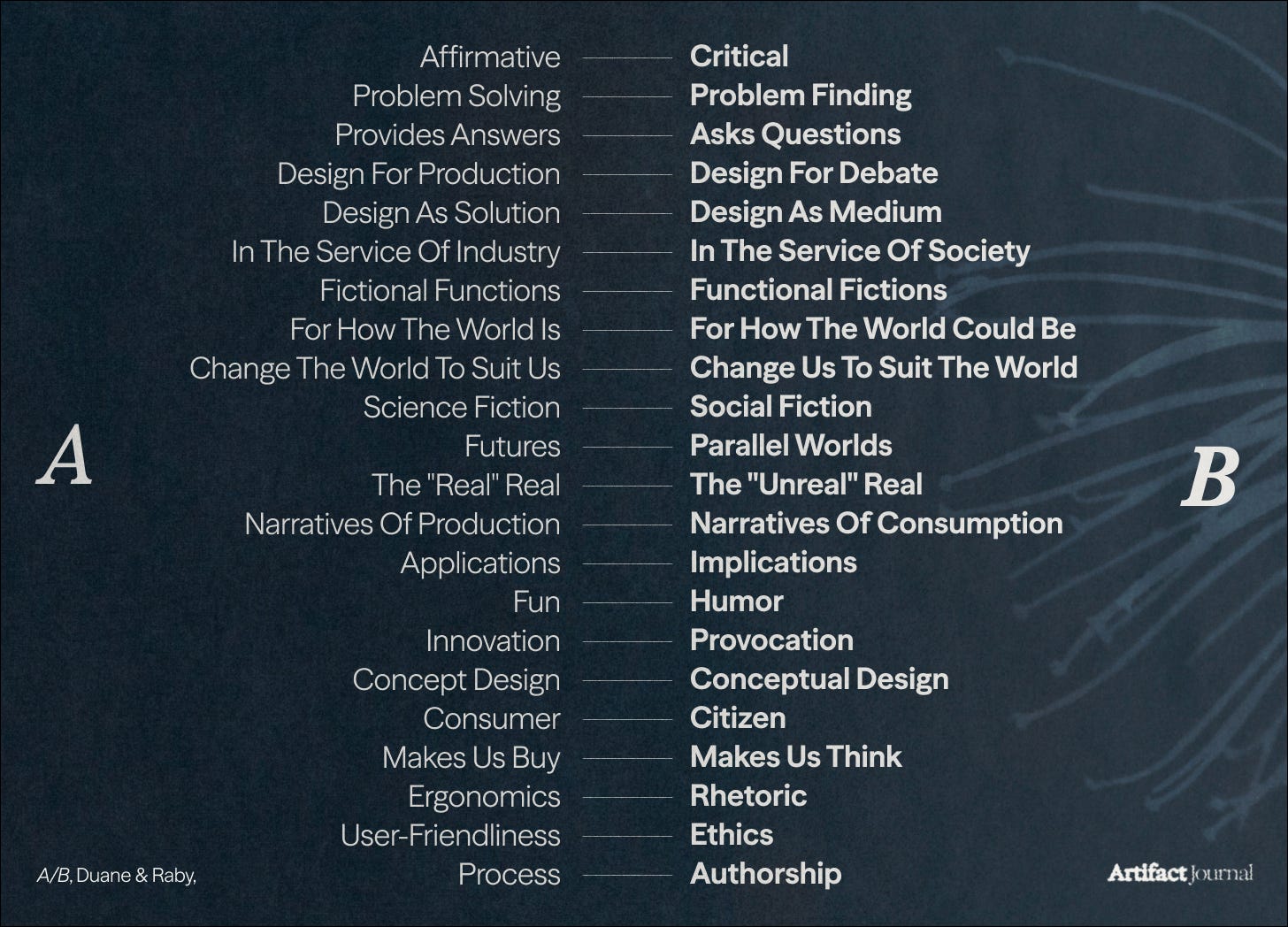
Examining the difference between Problem Solving (A) and Problem Finding (B), Bastien Kerspern notes in his essay Economic Design Fictions: Finding the Human Scale, “Design Fiction relies on a problem-finding approach rather than a problem-solving one. The latter has established its dogma in the entrepreneurial culture, and design thinking has been a major asset in the race to ‘make the world a better place’. It comes with recurrent injunctions to produce changes and even break things, as stated by the emblematic Silicon Valley gurus. Problem-finding, on the contrary, is all about understanding complex situations before attempting to fix anything that might even not be broken in the first place. It calls for intricate questions on the inter-influencing tensions between technologies, social issues, and political ideologies. By switching from problem-solving to problem-finding, design fictions are no longer addressing a facet of a problem but are investigating the very structural issues of a situation.”
Within this lens a well-designed experience might introduce friction to encourage reflection, with the ultimate goal of highlighting assumptions and reframing priorities. A design that considers how things could be – centering “Implications” over “Applications” to provoke debate and shift perceptions might escape the trap of putting lipstick on the pig. This approach situates design as a change-agent with a social obligation to critique and provoke systems-level cultural shifts that are measured by ideals and ideas, not product features. And it centers a process-focused ideal that makes design more accessible and universal for evolving social structures.
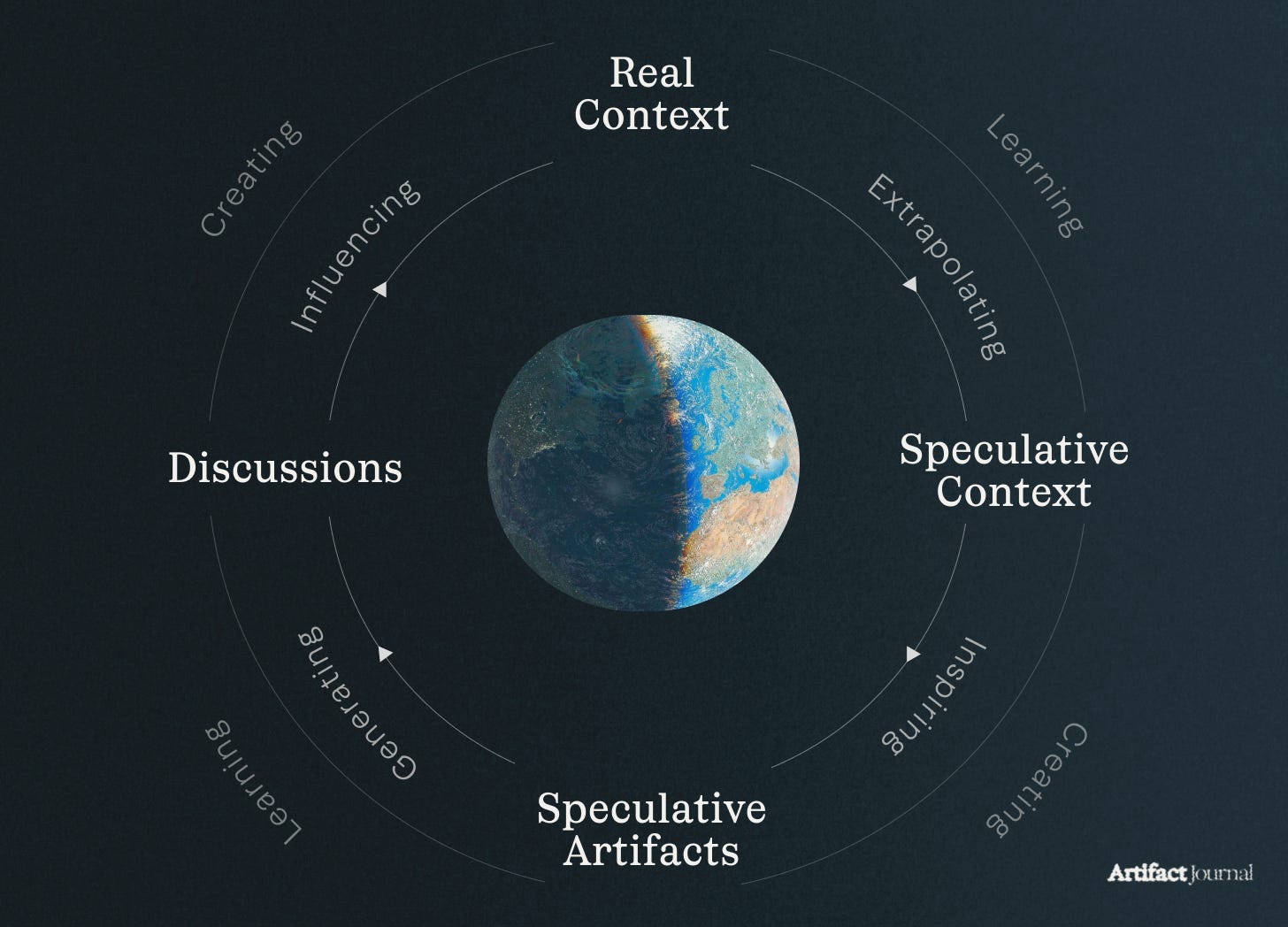
A Problem-Finding Design Process for…
Designers: A medium for practicing ethical foresight, looking beyond the brief, shifting perception, prototyping provocations and elevating ideals.
Researchers: A method for surfacing values, fears and assumptions around current and future states, developing actionable insights in partnership with design.
The Public & Policymakers: A vehicle for community building, civic laboratories, democratized futures-thinking, non-expert input and engagement.
Organizations: A protocol for interdisciplinary value-alignment, narrative-building, proactive risk-management and scenario building.
Archeology of Potential:
Understanding Design Fiction
Imagine walking alongside a river where sculptural devices dip into shallow water and tilt skyward, catching the movements of waterfowl overhead. Sensors gather birdsong, tidal shifts, and weather changes, feeding an AI trained on folklore and mythology. That AI then sends poetic messages to people in a nearby city — texts that weave scientific data with older, intuitive ways of knowing, nudging attention toward the living landscape just beyond the urban edge.
The design studio Superflux built exactly this, in their exhibition Nobody Told Me Rivers Dream. The work asks how AI might help us relearn the deeper languages of ecological intelligence — and what a different relationship with technology could feel like. It’s a strong example of Design Fiction doing what it does best: making an alternative reality tangible enough to take seriously.

Speculative Design & Design Fiction represent several disciplines and methods of design concerned with alternate states of being. Speculative Design is the practice of challenging the status quo and stimulating debate through the development of hypothetical scenarios. Design Fiction, born from the work of Julian Bleecker and Bruce Sterling, similarly involves the creation of future-artifacts, but situates them within the contextual narrative of an alternate world-state and is more concerned with world building than exclusive critique. Speculative design asks “should we?”; Design Fiction asks “what would it be like if we did?”
DESIGN FICTION:
The practice of creating tangible and evocative prototypes of material cultural artifacts from possible near futures, to help discover and represent the consequences of decision making.
(Source: Near Future Laboratory)
Design Fiction can be thought of as an archeology of potential futures. While archeologists study artifacts from the past to understand the cultural values and systems that produced them, speculative designers prototype fictional artifacts that describe conceptual near-futures. The provocations that arise from Design Fiction are not predictions, nor are they maps for implementation. They act as compasses that may set course towards, or away from, an understanding of reality. Their creation assists in that potential-reality being felt.
Without influencing real-world action Design Fiction risks becoming decorative make-believe or masturbatory black-mirrors. However, it is precisely due to the practice’s inherent ambiguity and interest in world-building that makes it a tool primed for the present. Qualities of Design Fiction that can be leveraged for better engagement and outcomes include:
Design as Medium

(Democratic & Un-disciplinary)
Focusing on asking good questions promotes the democratization of the design process. Leveraging design as a medium for exploration invites ambiguity, and rather than privileging expert opinions or ownership, encourages direct and organic engagement with outsider-perspectives. Positioning design as a liminal process guided by a set of values makes it inherently cross/un-disciplinary. This allows for the integration of research & design as a an ongoing conversation.
Gardener’s 12 suggestions for better civic technology in their Hey Mamdani! campaign emerged out of Open Assembly an open-format collaborative drafting session open to experts and community alike. The project serves as a great example of how process can build community while generating actionable insights and integrating audience engagement from the start.
Leveraging Narrative Technique

(Imaginative)
Design Fiction utilizes narrative techniques from science fiction, both literature and cinema, to aid in the suspension of belief and engage with broader audiences. Fictional stories enjoy greater popularity than design. World-building has been successfully deployed to bypass skepticism in series such as Black Mirror through modeling worlds that accurately reflect the potential risks of modern technology – not necessarily because of the technology itself but because of human fallibility.
Inferstudio’s animated series of short films, Ocean Futurisms asks questions about how humans will navigate ocean governance across various potential realities. The immersive world-building within the animations encourages audiences to grapple with potential outcomes, both good and bad.
Materializing Fictions

(Tangible)
Design Fiction centers on Diegetic Prototypes, objects that exist within a story world, embodying the fictional with tangible and interactive examples. The storytelling objects operate like props within a film, but unlike cinema, they sit in the foreground rather than the background. Diegetic Prototypes are often familiar and mundane objects that contextualize the conceptual within the familiar to create emotional investment.
The Fictional Brands Archive has catalogued hundreds of brands crafted for businesses and institutions across a range of fictional universes. These graphic artifacts passively tell the story of the worlds that manifested them while creating a familiarity with audiences that bridges reality and fiction. The relationships audiences build with these fictional enterprises have even resulted in instances of ‘de-fictionalization’ where fictional brands are transformed into real ones, suggesting potential well beyond cinematic marketing for leveraging fiction to influence reality.
Another World is Possible
Your Attention is Requested in a Better Reality
At a time when unprecedented events seem to occur daily, Speculative Design and Design Fiction lean into the uncertainty. They embrace disruption as opportunity. If and when the sky falls, perhaps it will find us dreaming of something better – ready to write a story untold.